Serving Benicia, CA and surrounding areas. (707) 750-8535
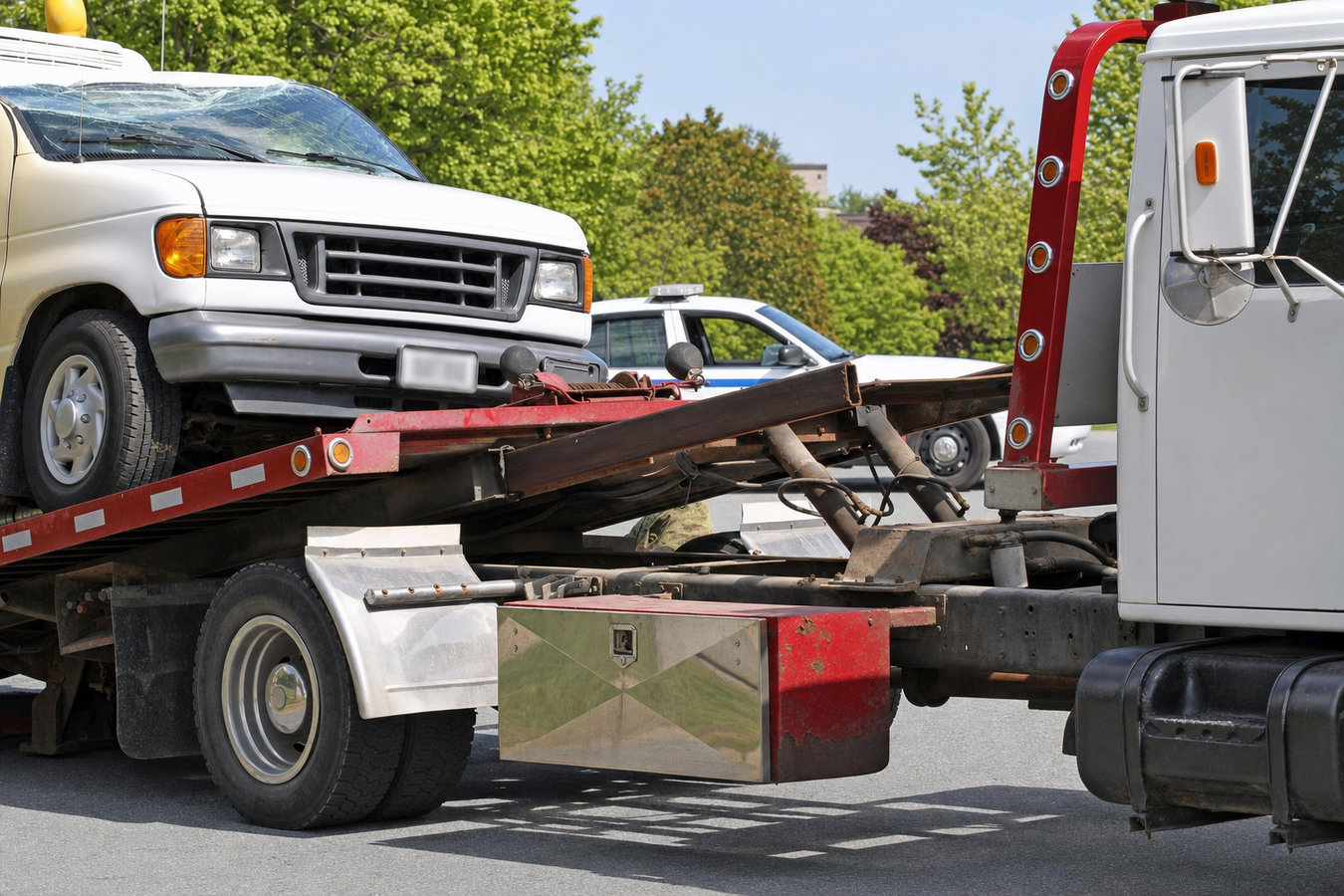
A police-ordered tow is stressful. We are on the Benicia Police Department approved rotation and can walk you through exactly where your vehicle is, what you need to bring, and how to get it released without paying more than you owe.
Police towing in Benicia means a Benicia Police Department officer or California Highway Patrol officer at the scene contacts an approved tow company from their rotation list - your vehicle is moved to a licensed storage facility, storage fees start immediately, and you are notified under California state law, often by phone or mail within a day of the tow.
A police-ordered tow is different from calling a towing company yourself. You did not choose who responded, and you may have had little time to gather your belongings before the vehicle was loaded - especially on a fast-moving freeway like I-680 or I-780. Understanding what to do next, and doing it quickly, is what keeps your total bill manageable. Storage fees do not pause on weekends or holidays. For situations where your vehicle was damaged in an incident before the tow, accident recovery covers the steps involved in recovering a vehicle from a collision scene.
If your vehicle is missing and you are not sure whether it was towed or stolen, call the Benicia Police Department first. A quick call confirms which situation you are dealing with and where your vehicle went - do not skip that step.
If your car is missing from where you parked it, the first step is a call to the Benicia Police Department to confirm whether it was towed by order of law enforcement or reported stolen. Do not assume - a quick call tells you exactly which situation you are in and where your vehicle was taken. Acting on the wrong assumption wastes time while fees accumulate.
If law enforcement ordered your vehicle towed from I-780 or I-680, it was moved quickly to keep the road clear. You may not have had time to gather your belongings or choose a drop-off location. Contact the ordering agency - either the Benicia Police Department or CHP, depending on where the incident occurred - to find out which storage yard received your vehicle and whether there is a hold on it.
Once your vehicle is in the storage yard, fees accumulate every day, including weekends. The sooner you act - confirming the location, gathering your documents, and arranging payment - the lower your total bill will be. Every day you wait adds to the total you owe before you can get your vehicle back.
Sometimes a vehicle cannot be released until the agency that ordered the tow clears a hold. This can happen after certain arrests, accidents under investigation, or other legal circumstances. You need to resolve the hold with the law-enforcement agency before the storage yard can release the car - the tow company cannot override that hold regardless of payment.
We operate on the Benicia Police Department approved tow rotation, which means we respond to police-ordered tows on Benicia city streets, parking violations, traffic stops, and accident scenes where the officer directs us. For freeway incidents on I-780 and I-680, we also work within the California Highway Patrol rotation for this corridor. Every vehicle we move is documented at pickup - the operator photographs the vehicle's condition before loading - which protects you if any question about damage comes up later. Vehicles requiring extended storage after a police-ordered tow go to our licensed storage facility, and you can review our posted rate schedule when you arrive. For situations where the vehicle was involved in a collision and needs recovery work before it can be moved, vehicle storage covers what happens once the vehicle arrives at the yard and what you need to know about fees and timelines.
We handle passenger cars, SUVs, and trucks using flatbed carriers for vehicles where all-wheel drive or low clearance makes wheel-lift towing unsafe, and wheel-lift for standard vehicles. Commercial vehicles towed by police order may require heavier equipment - we carry the right units for the vehicle types common in the Benicia Industrial Park and refinery corridor. Call us to confirm your vehicle's location, ask about the documents you need to bring, and find out whether there is a hold before you make the trip to the yard.
Police-ordered tows from Benicia city streets, parking violations, and traffic stops handled through the Benicia Police Department rotation.
Rapid response to incidents on I-780, I-680, and the Benicia-Martinez Bridge approach through the CHP approved rotation for this corridor.
Vehicles involved in collisions that law enforcement orders removed from the scene, including vehicles with damage affecting how they can be safely loaded.
Police-ordered removal of commercial vehicles and trucks requiring heavier equipment and operators with appropriate certifications for the vehicle type.
Benicia sits at the junction of I-780 and I-680, two busy Bay Area freeways carrying significant commuter and commercial traffic daily. The Benicia-Martinez Bridge on I-680 is a high-traffic chokepoint where incidents require rapid response - a vehicle disabled on the bridge or its approach ramps is a safety hazard that law enforcement moves quickly. That speed means the owner may have very little warning before the tow happens. The industrial waterfront also generates commercial vehicle traffic that occasionally requires police-ordered removal when a truck is blocking a road or has been involved in an incident. Drivers coming off the bridge from Martinez, CA and entering Benicia via I-680 are in one of the highest-incident sections of this corridor.
Peak-hour congestion on I-680 and I-780 can affect how quickly a tow truck reaches an incident scene during morning and evening commutes. During heavy traffic periods, your vehicle may sit on the shoulder longer before it is moved - and storage fees begin the moment it arrives at the yard, not when the officer calls it in. Tule fog on the bridge and its approaches in fall and winter mornings is also a factor in incident frequency on this stretch. Drivers traveling through Vallejo, CA on I-80 and connecting to I-780 through the Benicia corridor see similar conditions at the interchange.
The officer at the scene contacts a company from the BPD or CHP approved rotation - you do not choose who responds. On a busy freeway like I-680, the window to gather belongings from the vehicle is very short. The operator assesses the vehicle and uses the appropriate loading method for your vehicle type.
Your vehicle is taken to a licensed storage facility and daily storage charges begin immediately. California law requires the tow company to notify the registered owner within a defined window. If your vehicle is missing and you have not heard anything, contact BPD directly rather than waiting for the notice to arrive.
Call the storage yard before heading over. Confirm your vehicle is there, ask what documents to bring, and find out whether there is a law-enforcement hold. If there is a hold, you will need to resolve it with the ordering agency first - the yard cannot release the vehicle until that hold is lifted.
Bring your photo ID, registration or title, and payment. Ask to see the posted rate schedule and verify your charges match the regulated rates. Once payment is made and the hold - if any - is cleared, do a walk-around before you drive away and note any concerns on the paperwork before the yard closes the transaction.
We can tell you exactly where your vehicle is, what documents you need to bring, and how to get it released - including after a freeway tow on I-680 or I-780.
(707) 750-8535To work police-ordered tows in Benicia, a company must be vetted and approved by the department - meeting their requirements for equipment, insurance, and operator qualifications. That approval is your assurance that the company handling your vehicle cleared a real standard set by local authorities, not just showed up.
Incidents on I-680 and I-780 are handled through the California Highway Patrol approved rotation, which has its own equipment and qualification requirements separate from city tows. We operate on both lists, so whether your incident happened on a Benicia street or on the bridge approach, the same company is accountable.
California requires storage facilities to post their rate schedules where you can see them, and police-ordered tow rates are subject to regulation. We walk you through the charges so you can verify them against the posted rates before you pay - and if something does not match, you have the right to request a post-storage hearing through the ordering agency.
Membership in the Towing and Recovery Association of America connects us to industry-wide standards, training resources, and professional accountability. It is a sign that we take the work seriously beyond the minimum required by law - relevant when your vehicle is being handled in a high-pressure, high-traffic situation on the I-680 bridge corridor.
A police tow is not the end of a bad day - it is a process with clear steps, regulated rates, and rights you can enforce. We operate transparently so you can hold us accountable, and we will walk you through your options if anything about the process does not seem right. More information on California vehicle impoundment rights is available through the California Highway Patrol and the Towing and Recovery Association of America.
After a police tow, your vehicle goes to a licensed storage facility. We explain what the daily fees cover, how the release process works, and how long you have before the lien process begins.
Learn MoreIf law enforcement ordered your vehicle towed because it was in a collision, accident recovery covers the scene work and the steps to get a damaged vehicle safely loaded and moved.
Learn MoreStorage fees start the moment your vehicle arrives at the yard. Call us today to find out exactly where it is and what you need to get it released.